Across India, rapid infrastructure development often presents a difficult challenge: how can progress move forward without erasing centuries of history and cultural heritage?
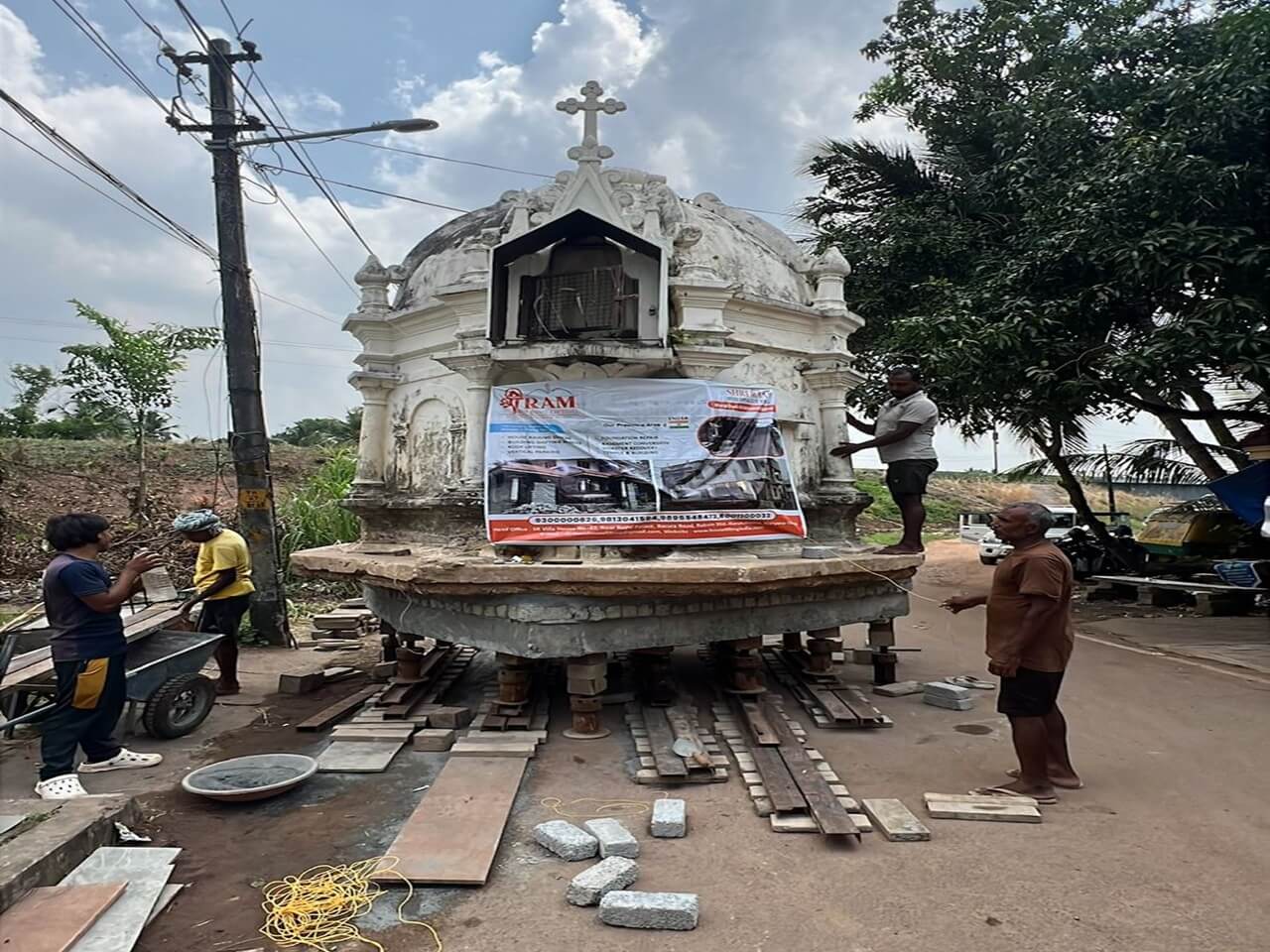
A remarkable example of this balance recently emerged in Kerala, where a 200-year-old Christian shrine was successfully relocated rather than demolished to make way for a railway expansion project. What could have become another story of heritage loss instead became a powerful demonstration of how faith, community determination, and modern engineering can work together to preserve history.
The project has drawn national attention not only because of the shrine’s age but also because of the innovative building-lifting technology used to move the structure safely to a new location.
A Christian Shrine That Carried Two Centuries of History
Located near St. John’s Nepumsian Church in Konthuruthy, Kochi, the historic roadside shrine had stood as a symbol of devotion for more than 200 years. Built in the early 19th century, the Portuguese-style structure served generations of worshippers and became deeply connected to the identity of the local community.
When railway authorities acquired land for track expansion and modernization, the shrine found itself directly in the path of the proposed development. For many communities, such situations often lead to difficult choices between development and preservation.
However, parishioners were determined to protect a structure that represented both their faith and local history.
Community Effort Saved the Shrine
Rather than accepting demolition, members of the church community explored alternative solutions. They worked closely with authorities and sought permission to relocate the shrine intact.
The congregation even arranged for a nearby plot where the shrine could continue serving worshippers while allowing the railway project to proceed. This collaborative approach demonstrated that infrastructure development and heritage conservation do not have to be opposing forces.
The decision was significant because the structure was not merely a building. It held emotional, historical, and spiritual value accumulated over generations.
The Engineering Behind the Move
Relocating a centuries-old masonry structure is a highly specialized task. Even minor mistakes can result in cracks, structural damage, or complete collapse.
To ensure safe relocation, engineers first separated the shrine from its original foundation. Hydraulic jacks were then strategically installed beneath the structure to lift it uniformly.
After elevation, specially designed beams, channels, and temporary tracks were positioned underneath. The shrine was gradually moved over a distance of approximately 26 metres while maintaining structural stability throughout the operation.
Similar engineering principles are used in SRBL’s
temple lifting services and
building shifting services, where historic and occupied structures are relocated without demolition.
Unlike conventional demolition and reconstruction, this method preserves the original heritage fabric, architectural details, and historical authenticity of the structure.
The successful relocation highlights how modern building-lifting technology can save heritage assets that would otherwise be lost forever.
Why Building Relocation Matters
India possesses thousands of temples, churches, shrines, havelis, and heritage buildings that face threats from road widening, railway expansion, urban development, and flood mitigation projects.
Historically, many of these structures were demolished because relocation was considered impossible or too risky.
Today, advanced lifting and shifting technologies have transformed what is possible.
Building relocation offers several advantages:
Preserves Historical Identity
Original structures retain their authenticity, craftsmanship, and cultural value.
Reduces Reconstruction Costs
Demolition and rebuilding often cost significantly more than relocation while sacrificing historical integrity.
Protects Community Sentiments
Religious and heritage structures often hold emotional significance that cannot be recreated through new construction.
Supports Sustainable Development
Relocation allows infrastructure projects to proceed while minimizing heritage loss.
The Kerala shrine project demonstrates how these benefits can be achieved through proper planning and engineering expertise.
Heritage Conservation Through Structural Lifting
The successful movement of the shrine reflects a growing trend worldwide: conserving heritage through structural relocation rather than demolition.
Advanced hydraulic lifting systems can now handle:
* Temples
* Churches
* Mosques
* Historic buildings
* Heritage monuments
* Schools and public buildings
* Residential structures
These techniques are particularly valuable when development projects intersect with historically important structures.
As cities expand and infrastructure requirements increase, engineering solutions like building lifting are becoming critical tools for heritage preservation.
SRBL’s Contribution to Temple and Heritage Structure Lifting
At Shri Ram Building Lifting (SRBL), heritage conservation has always been more than an engineering challenge—it is a responsibility.
Over the years, SRBL has successfully lifted and relocated numerous residential, commercial, and heritage structures across India using advanced hydraulic lifting technology.
One of the most notable examples is the successful lifting and preservation of the historic Gopalji Temple in Odisha. Estimated to be approximately 650 years old, the temple relocation project demonstrated how ancient religious structures can be protected without compromising their historical significance. The achievement gained widespread recognition and showcased India’s growing capabilities in heritage engineering.
Projects involving temples and heritage structures require exceptional precision because even minor damage can affect architectural integrity and cultural value.
SRBL’s experienced engineering teams carefully evaluate every structure, design customized lifting solutions, and execute relocation with a strong focus on safety and preservation.
The Future of Heritage Preservation in India
The Kerala shrine relocation offers an important lesson for future infrastructure projects across the country.
Development and conservation should not be viewed as competing priorities. With the right engineering expertise, historical structures can be preserved while allowing essential public projects to move forward.
As India continues investing in railways, highways, urban redevelopment, and flood management projects, the demand for professional building-lifting and relocation services is expected to grow significantly.
Innovative engineering solutions will play a vital role in ensuring that future generations can continue to experience the country’s rich architectural and cultural heritage.
Conclusion
The successful relocation of the 200-year-old shrine in Kerala stands as an inspiring example of what can be achieved when communities, authorities, and engineering professionals work together.
Rather than allowing history to disappear under the pressures of modern development, parishioners chose preservation. Through advanced lifting and shifting techniques, a cherished landmark was saved, proving that heritage conservation and infrastructure progress can coexist.
For organizations and communities facing similar challenges, the project serves as a reminder that demolition is not always the only option. With specialized expertise and proven technology, even centuries-old structures can be protected and preserved for future generations.
At SRBL, we remain committed to helping preserve India’s architectural and religious heritage through safe, innovative, and reliable building lifting and temple relocation solutions.
Frequently Asked Questions
Can a temple be shifted without demolition? Yes. Modern hydraulic lifting technology allows entire temples and heritage structures to be safely relocated. Learn more about our
temple lifting services.
How much does building lifting cost in India? The cost depends on the structure size, foundation condition, and lifting requirements. Visit our
house lifting cost guide for detailed information.
Does SRBL relocate heritage buildings?
Yes. SRBL has extensive experience in Heritage Structure Relocation, temple shifting, and preservation projects across India.
How can I get a consultation for temple lifting?
You can reach out through our
Contact SRBL page to schedule a site inspection and engineering assessment.
June 25th, 2026